
Foundations: CoStar, the Company That Organized Commercial Real Estate
How one man's vision transformed an entire industry.

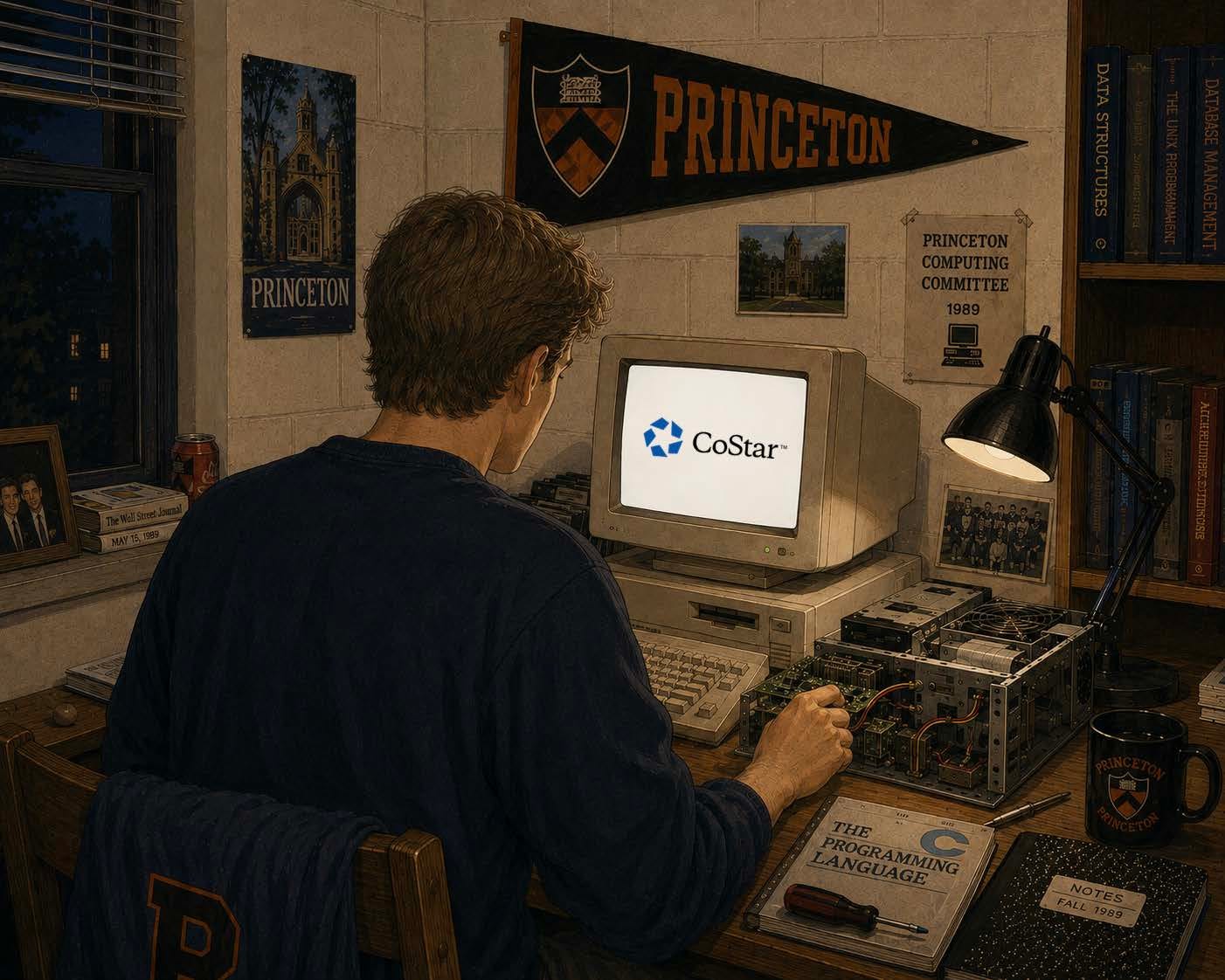
In 1986, in the glow of his desk lamp inside a cramped Princeton dorm room, a young Andrew Florance sat hunched over a self-modified computer, unknowingly laying the groundwork for what would become a billion-dollar real estate empire. More specifically: he was creating a model for a new kind of financial real estate data service, an early version of an idea that would eventually become CoStar. If you’re reading this real estate-focused Substack and aren’t familiar with CoStar, it would be quite surprising, but just in case: it is the leading global provider of commercial and residential real estate data. And it was the first of its kind.
The concept was simple: take publicly available data, such as city records, and organize it, city by city, into something far more accessible than the scattered paper files real estate brokers and investors relied on for years. Simple, perhaps, but labor-intensive. Florance called brokers. He pulled public city filings by hand. Digitizing each piece of information, Florance built the first version of the database, aided only by an unreasonable volume of patience that most of us can’t even fathom. It was initially intended as just a fun project he expected to fill a year of his time before returning to grad school; it eventually snowballed into an S&P 500 company.
A Nature and Nurture Story
Florance was trying to fix a problem many in the industry had learned to live with. Despite commercial real estate being a multi-trillion-dollar sector, literally the world’s largest asset class, it had one major flaw: the industry had little to no organized information behind it. While Wall Street could track a stock’s price down to the second, in part thanks to the relatively recent debut of the Bloomberg Terminal, billion-dollar deals in commercial real estate were often made using fragmented data, half-remembered conversations, and outdated paper records.
Florance was uniquely positioned to see the gap he set out to fill. The stereotype that, at some point, we all turn into our parents wasn’t far off in Florance’s case. He didn’t just happen to find his way into the built world; he was raised in it. His father, Coke Florance, was a notable architect who designed many buildings in the Washington, D.C. area, including Capital One Arena, home to the NBA’s Washington Wizards, while his mother was a realtor. He grew up sandwiched between two sides of the industry. His father designed buildings, and his mother sold them.
This early exposure to the built world followed him to Princeton, where he studied economics but soon found a second interest, computers. During his time in undergrad, Florance got his hands on his first-ever personal computer and became connected to a community of fellow enthusiasts he met through the computing committee. While in school, he also began working for a Washington, D.C.-based developer, which put him in contact with real estate finance. It was this position that made Florance realize how much of the data behind these models was essentially invented or loosely estimated. Reliable information for commercial real estate simply did not exist.
After graduating, Florance continued building the business, compiling listings and data. However, a year working as a team of one proved unsustainable, and he went broke. His company managed to stay afloat by a fortunate alignment of timing and circumstance. It was the height of the S&L crisis, and Michael Klein, a local D.C attorney, was tired of banks losing money on commercial real estate loans. He stumbled across Florance’s work and began assembling a pool of investors. This funding pulled Florance from the brink of debt and helped him launch The Realty Information Group from his parents’ basement. Yes, as cliché as it sounds, Florance would soon join the list of multi-billion dollar entrepreneurs who began their companies in less than romantic environments. For his physics lab partner, Jeff Bezos, it was a garage. For Florance, it was his parents’ basement.
With funding finally behind him, Florance turned to the next problem: the real estate brokers he sought to sell his software-based product to largely didn’t have computers. The industry he was looking to modernize was still entirely paper-based. So, he introduced a companion product that met the brokers where they were, and packaged his data into a phone book-sized monthly leasing guide called Cornerstone.
Thus began the slow, meticulous work of building a real estate database market by market and city by city. He cold-called brokers, surveyed buildings in person, and cross-referenced hundreds of public filings. After three years, he sold Cornerstone, despite its success, and used the proceeds to power Realty Information Group’s growth.
That money helped them grow from Washington, D.C., to Baltimore and New York in 1994, and later expand to Los Angeles, Orange County, Chicago, Philadelphia, and San Francisco. This growth came primarily from acquisition and outperforming smaller rivals, buying data sets, and compiling them into their own platform.
Going Public and Buying the Competition
By 1998, Realty Information Group was thriving, generating revenue from two core products. CoStar, which provided office and industrial real estate professionals the tools to analyze market conditions and leasing options, and CrosTrac, which helped tenants find space and building owners fill vacancies. The following year, the company went public, raising $23 million in its IPO. A second stock offering not long after quadrupled that total, further supporting CoStar’s continued expansion and rising influence on the built world. That same year, in 1999, the company was renamed CoStar.
The funding they received completely altered the company’s growth, and from that point on, CoStar followed a consistent pattern. They used their capital to spot undervalued opportunities and acquire complementary or even rival businesses like LeaseTrends and ARES. This strategy enabled them to absorb more proprietary data and fold it into their existing system. The more data they accrued, the harder it became for any competitor to replicate their platform.
The company was also adept at finding clever methods to illustrate the value of its data. In 2009, CoStar purchased their headquarters from the Mortgage Bankers Association for $41.3 million; just two years earlier, the same building sold for $79 million. The story, which they broadcast quite publicly, was that they used their own data and analytics platform to identify the optimal time to buy, which was how they achieved such a phenomenal discount. If that sounds like a flex, well, that was the point.
Florance’s strategy to purchase the competition out of existence perhaps reached its apotheosis in 2011, with the $860 million acquisition of LoopNet. By this point, CoStar’s business had become as much about advertising available commercial space as aggregating data, so CoStar sought to acquire its largest and most direct competitor in commercial real estate listings. LoopNet built the largest free, ad-supported listing marketplace, where brokers and landlords listed commercial properties for sale or lease, making them both a threat and target. The merger of the two rival companies meant combining CoStar’s proprietary data and analytics, only accessible by subscription, with LoopNet’s open commercial property marketplace information. Merging the two companies achieved two strategic purposes in a single strike. One: CoStar neutralized their main competitor in commercial property marketing, further asserting its dominance in the commercial real estate sector. Two: CoStar repositioned itself as a funnel, using LoopNet’s reach to draw users in and convert that traffic into paying customers rather than shutting them down completely. Aggressive? Perhaps. Effective? Definitely. CoStar neutralized its most direct competitor in the space, turning its rival into a marketing tool.
In 2014, CoStar bought Apartments.com for $585 million, marking their first step in consumer-facing rentals. A decade later, they bought Matterport, an immersive spatial mapping tool, for $1.6 billion, and, to establish themselves in the Asia Pacific property market, Domain Holdings Australia for $1.92 billion.
However, not every bet has paid off cleanly; Homes.com has become CoStar’s most controversial acquisition yet. Activist investors like D.E Shaw and Third Point have argued CoStar has poured billions into a money-losing residential platform, losing sight of the commercial focus of their business. Yet CoStar and Florance have both pushed back, defending their investment as a long-term strategy. Even with this recent hiccup, in total, CoStar has made over 40 successful acquisitions since the company’s start. If you’re an aggressive real estate data startup, take this as a sign to watch your back (and your wallet).
Building a Moat
As CoStar continued to build, they also constructed walls around what they created. CoStar’s legal records show they take the protection of their intellectual property very seriously. Known for aggressive litigation, CoStar has filed dozens of lawsuits against competitors in the field. One of their biggest battles began in 2020 against Crexi, one of the most popular and quickly growing commercial real estate platforms. CoStar sued Crexi for copyright infringement after they wrongfully accessed the LoopNet site, copying listings and cropping out CoStar’s watermark from tens of thousands of CoStar-owned photos. History repeated itself in 2025, when CoStar also filed a lawsuit against Zillow for infringing 53,000 copyrighted images.
CoStar’s commitment to protecting what it has built demonstrates the same mindset Andrew Florance brought to his project since the very beginning. What makes CoStar’s foundation so remarkable isn’t just the scope of the complex data that needed to be organized to execute such a bold idea. It is the drive and determination that enabled the company’s growth and success. Florance had the persistence necessary to organize information, expand the market, and push the built world to adapt. What started as a dorm room experiment became the foundation of a publicly traded, multibillion-dollar company and proof that some of the world’s largest industries can be shaped by someone willing to do the work.
Not too bad for a guy who just wanted a year off grad school.
 |
|