
The Bloxspring Essential Eight: Abid Butt
The Hospitality and Development CEO Offers a Worldly Perspective

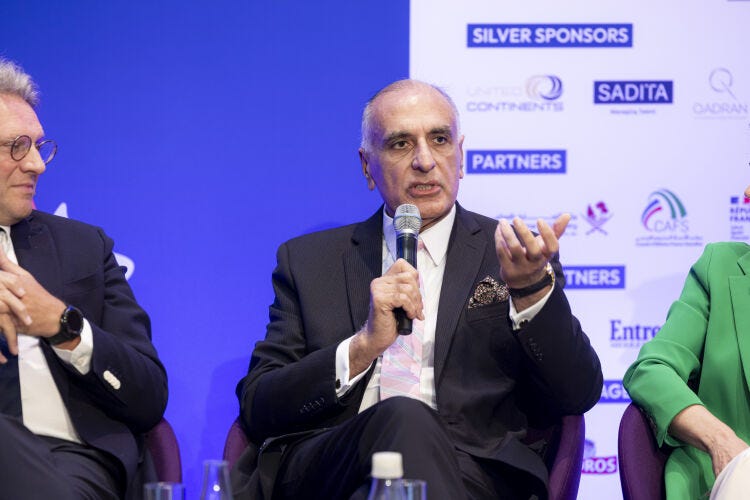
At Bloxspring, we know that there’s a time and a place for a good cliche.
In general, as the premier storytelling agency focused on the built world—the Faulkners of foundations, the Fitzgeralds of FAR—we strive to avoid cliches. But, every once in a while, a particular aphorism is so apt that it’s best not to resist it, but rather plunge straight in.
Such is the case here, in this moment, when we describe today’s fearless subject of the Bloxspring Essential Eight, one Abid Butt, as a “man of the world.”
These days, Butt resides not far from me, in the DC suburbs of Maryland. But over the course of his illustrious career in the hospitality and real estate industry, he’s worked and lived in Hawaii, Indonesia, Thailand, and Singapore. And he’s conducted business and led developments throughout Asia Pacific, the Middle East, Europe, and North America.
Most recently, he was based in Qatar, where he served as the Group CEO of the ASSETS Group, a diversified developer with a portfolio totaling more than $9 billion. Previously, he was the CEO of the Dream Hotel Group, and prior to that experience, he acted in the same role for Banyan Tree Hotels & Resorts.
Now, as he’s returned to the United States to spend more time with his family and contemplate his next professional endeavor, Butt was kind enough to subject himself to the rigors of the “Essential Eight.” During our conversation, we touched on an array of topics including how one goes from a lab coat, to a chef’s coat, to a developer’s power suit; why aged regulations are hampering development; and how prefab construction could be a game changer (another cliche!) for development in remote areas.
How did you initially get involved with the real estate industry?
It was somewhat of a fluke. My background has largely been in hospitality and travel, though—if you can believe it—I originally wanted to go to medical school. I traded a white lab coat for a white chef’s coat and headed to culinary school instead. I loved it and worked in kitchens for a while before eventually moving into the hotel industry.
As I grew within that sector, I quickly learned how capital-intensive hotels are. Competition is fierce, and you constantly must outperform your neighbors. That means keeping up with upgrades, and hotels typically go through a major renovation cycle every seven to eight years. A large property can require $70–80 million in renovations, with nearly everything torn down and rebuilt. That was my first real introduction to the world of real estate.
Throughout my career, I had the opportunity to lead a variety of projects—from renovating existing assets in Hawaii to helping plan the development of nearly 700 acres of waterfront land with new hotels and residential units. I also worked across global markets, developing in different regions and learning the unique dynamics of each.
So, no—this path was not planned. But it has been an unexpected and incredibly rewarding journey.
What’s the most unexpected aspect of how your career has evolved?
In many ways, what initially drew me to the hotel business was the glamour. I would watch TV shows or visit someone in a hotel and think, “what a fabulous environment, everyone seems to be having fun and enjoying themselves.” I have to admit, I never thought I would eventually pivot into development. Ownership, perhaps, working with existing assets, doing adaptive reuse, or repositioning properties for their highest and best use. But 10, 15, even 20 years ago, if you had asked me, I never would have predicted becoming a developer.
That said, I have been very fortunate. Growing into this role has allowed me to bridge the gap between operations and development across different asset classes.
I understand firsthand how decisions made during construction can end up costing multiples once you start operating. That operational perspective has served me incredibly well and shaped how I approach every project.
What advice would you give to someone entering the industry today?
Find a mentor who can truly show you the ropes. The construction and development industries are full of complexities, and yesterday I was discussing this same topic with students from Johns Hopkins, my alma mater, entering the real estate world.
Development is a massive puzzle with many moving parts. You need to understand how each task and discipline supports the final goal, but no one can be an expert in all of them. That’s why having a mentor early on is invaluable. And when you eventually step into a leadership role, surround yourself with people who will meaningfully contribute and challenge your assumptions. That pushback and diversity of thought ensures the final product is as strong as it can be.
Because, in this industry, no one person can be master of all trades.
What has surprised you most about how the built world and the real estate industry have changed since your career began?
When I first entered the industry, there were only a couple of dominant asset classes, residential and office towers. But that landscape has completely changed.
Office buildings, for instance, have evolved dramatically. There’s now significant overlap between offices and hotels in terms of amenities and the overall user experience. It’s no longer about putting up a shell and core and squeezing 50 desks into 50 square meters. Employers have recognized the value of creating inviting, engaging work environments. Amenities that were never even considered when I started are now expected.
Residential has also become far more specialized. It used to be one-size-fits-all, but today multifamily alone includes everything from active-adult living to adults-only communities, urban developments, and resort-style destinations. Each segment has its own priorities and design requirements.
Industrial real estate has transformed as well. With Amazon’s rise and the explosion of logistics, warehousing is now a highly technical, infrastructure-heavy asset class. What used to be a grungy building in a part of town no one cared about has evolved into sophisticated, strategically located facilities driven by technology and efficiency.
Even healthcare properties have undergone a shift. At my last organization, we developed a hospital where we intentionally borrowed elements from hospitality, using natural light, warm materials, and thoughtful design to create a welcoming, uplifting environment for patients. Gone are the dull yellow walls and sterile laminate floors that used to be common in the space.
Seeing how all these asset types have evolved over the years has been truly remarkable.
What’s your favorite aspect of working in the real estate industry?
Being able to start with nothing more than a piece of dirt and then plan, design, and ultimately bring a building to life, that is incredibly gratifying.
You begin with vacant land, and then the creative minds, the architects and engineers, transform the vision on paper. The operations teams ensure it will function efficiently, and ultimately the consumer determines what makes it successful. Every stakeholder contributes something essential.
And when the building is finally completed, activated, and begins to take on a life of its own, it’s a truly remarkable feeling. After all the collaboration, challenges, and collective effort, there is so much to celebrate once a project comes together.
What’s your least favorite aspect of working in the real estate industry?
Honestly, the industry is not evolving fast enough—whether it is technology adoption, new materials, sustainability practices, or even design elements.
I do understand why. Real estate is an expensive undertaking, not a hobby, and you need a well thought out plan before embarking on a project. But generally speaking, the industry is still slow to innovate. Construction is a good example. We’re largely doing things the same way we always have. Prefab housing emerged on the single-family side, but it hasn’t truly taken off. And when you look at large-scale development, the methods remain relatively archaic.
The encouraging part is that there is a tremendous amount of work being done around new sustainable materials, new construction techniques, and both construction tech and real estate tech.
But in terms of what happens on the ground today, I must confess, it often still feels like we are operating in the Flintstone days.
What do you think is the biggest challenge facing the industry today?
There are two major challenges, in my view: regulations and labor. Internationally the picture varies, but in the U.S. market especially, labor is going to be a significant issue. We’re facing an acute shortage of skilled workers.
On the regulatory side, cities, counties, and states need to update their frameworks and make them more business friendly. They don’t have to give everything away, but they do need to create an environment where developers are willing to take development risks, create jobs, and build communities. Many building codes are outdated, and we need to reassess what’s relevant today, how processes can be streamlined, and how technology can be better deployed.
Labor is equally critical. Historically, the U.S. construction industry relied heavily on foreign labor, but that may not be sustainable going forward. Regardless, we need people who actually want to do this work. If the industry is perceived as a grind, young people won’t enter it. If the work isn’t attractive, financially, technologically, or professionally, there won’t be a pipeline of skilled labor to meet the demand.
That’s why vocational training is so important. Schools and training programs need to expose young people to the opportunities in construction and development. There are great careers to be built for those who are well educated, comfortable with technology, and open to new building methods. Whether the workforce is domestic or foreign, we must make the industry more appealing and efficient if we want to address the shortages ahead.
What makes you optimistic about the future of the built world?
I think technology will fundamentally change the industry. In many ways, it’s ripe for disruption.
For example, we may never move entirely to prefab construction but imagine embedding RFID chips into different components of a building, concrete slabs, structural panels, prefab sections. With that kind of embedded intelligence, assembling the “jigsaw puzzle” becomes far more efficient because you are not trying to build every single piece on site.
This isn’t as critical when you’re working near major metropolitan areas, but when you’re developing in remote locations or on small islands where every piece of material has to be shipped in, it becomes a massive challenge. Not just from a labor standpoint, but from a supply-chain perspective as well. Technology has the potential to meaningfully reduce those inefficiencies.
This interview has been edited for concision and clarity.